

The next era of online growth will be won by people, not platforms.
That statement sounds obvious at first. But it is actually a reversal of how the internet has worked for a long time.
For years, platforms felt like the source of power. If you could figure out the algorithm, the posting cadence, the format, or the latest growth trick, you could grow fast. You didn’t need people to trust you yet. You just needed them to see you.
That worked when attention was scarce.
It does not work anymore.
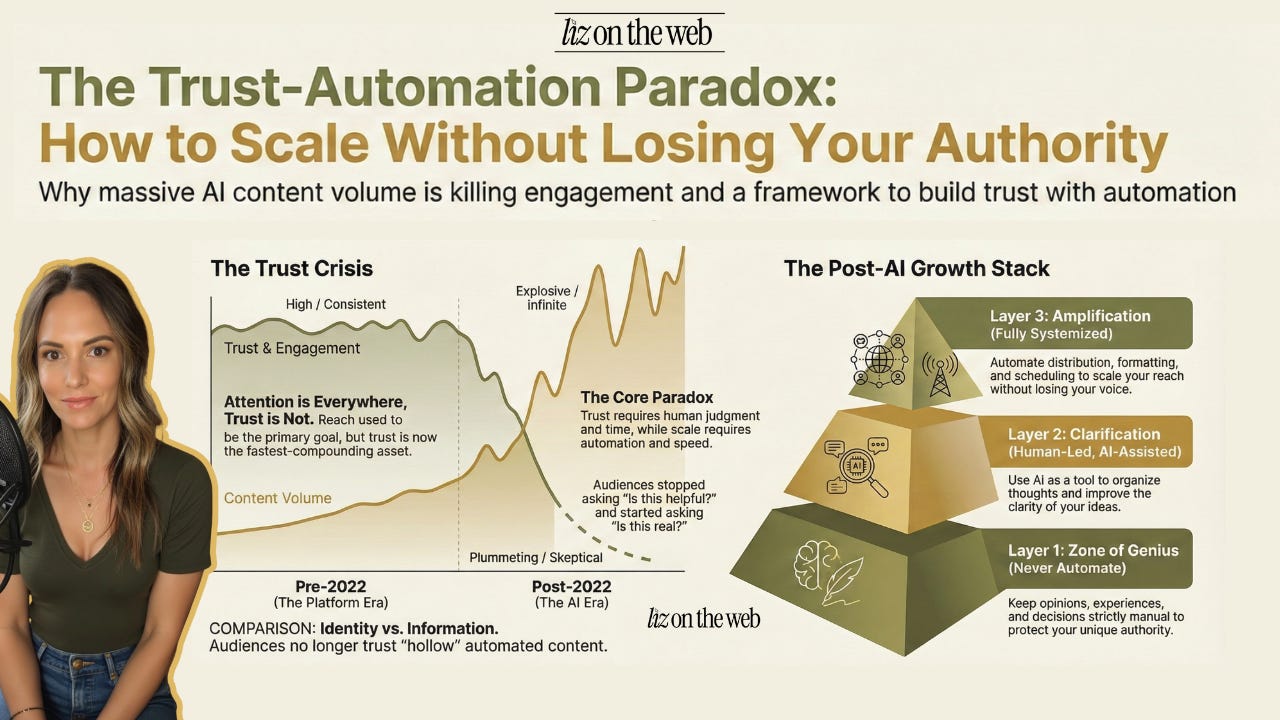
Today, attention is everywhere. Trust is not.
And trust now grows faster than reach.
This Shift Affects More Than Creators
This is not just a creator problem.
It affects:
founders building startups
solopreneurs selling services
consultants and coaches
small business owners
personal brands
thought leaders
anyone trying to grow online and make money online
If your business depends on people believing you, choosing you, or buying from you, this shift matters.
The rules did not disappear.
They changed.
We Are Living in a Trust-Constrained World
Since around 2022, the internet has changed very quickly.
AI tools made it easy to:
write posts in seconds
generate videos instantly
publish every day without much thinking
sound confident without experience
As a result, the amount of content online exploded.
But something important happened at the same time.
Across social platforms, newsletters, blogs, and video platforms, average engagement per post went down. People scroll more, but they interact less. They save less. They buy less.
This tells us something important.
People are not overwhelmed by information.
They are overwhelmed by information they don’t trust.
When people don’t know who to believe, they slow down.
When they slow down, growth slows down.
This is not an attention crisis.
It is a trust crisis.
AI & Automation Didn’t Ruin Content. They Ruined Trust.
Before, average content could still stand out.
A decent tip or a clean framework could feel useful simply because fewer people were publishing and the likelihood of automated regurgitation was low.
Now, anyone can publish at unprecedented scale.
Anyone can sound real.
Anyone can fake it — massively.
So audiences adapted.
They stopped asking:
“Is this helpful?”
And started asking:
“Is this real?”
“Is this legit?”
Now, people want to know:
who is behind this
what experience they actually have
whether they have something at stake
whether they believe their own advice
This is why identity suddenly matters so much.
Trust Is Not a Soft Concept. It Is an Economic Lever.
Trust is often talked about like a feeling.
In reality, trust changes how money moves.
When people trust you:
they buy faster
they hesitate less
they pay more
they refer others
they stay longer
When people don’t trust you:
they compare endlessly
they ask more questions
they delay decisions
they leave easily
This is why two people selling the same offer can have wildly different results.
Reach opens the door.
Trust gets people to walk through it.
In a world full of noise, belief becomes the bottleneck.
Why Identity-Based Platforms Are Gaining Power
This is why platforms tied to real identity feel different right now.
On LinkedIn:
your real name is visible
your work history is public
your reputation follows you
If you exaggerate or fake expertise, it can hurt your career.
On Substack:
writing takes time
ideas stay public
opinions can be checked later
automation is limited
These platforms create friction on purpose.
That friction filters out:
low-effort content
fake authority
people who don’t want accountability
They don’t reward speed.
They reward responsibility.
That’s why trust grows there.
Why Personal Brands Are Winning on Every Platform
The same pattern shows up everywhere else.
People trust:
faces
voices
stories
people who show their thinking
people who build in public
They do not trust:
faceless advice accounts
recycled content
generic tips
content that feels interchangeable
Watching someone build something over time builds trust because it shows:
effort
decision-making
risk
learning
This is not entertainment.
It is proof.
The Trust–Automation Paradox
This is the core idea.
Trust and scale want different things.
Trust requires:
human judgment
real experience
accountability
time
something to lose
Scale requires:
systems
automation
repetition
speed
AI makes scaling easier than ever.
AI also makes it easier than ever to remove the human part.
That is the paradox.
The question is not whether to use AI.
The question is where to use it.
The Most Common Mistake Businesses Make With AI
Most businesses automate the wrong parts.
They automate:
thinking
opinions
strategy
insight
And stay manual on:
posting
formatting
distribution
This feels efficient, but it breaks trust.
When thinking is automated:
content feels hollow
voices blur together
people sense something is off
When distribution is automated:
no one minds
no one feels misled
no trust is lost
This mistake is exactly what creates AI slop.
The Post-AI Growth Stack
Think of growth as three layers stacked on top of each other.
Layer 1: Your Zone of Genius
Never automate this.
This is where trust comes from.
It includes:
your opinions
your experience
your decisions
your mistakes
your predictions
This layer is hard.
It takes time.
It requires responsibility.
That is exactly why it matters.
People follow you for this layer.
Layer 2: Making Ideas Clear
Human-led, AI-assisted.
This layer is about:
organizing thoughts
explaining ideas clearly
choosing the right words
making things easier to understand
AI can help clean things up here.
It should not decide what you believe.
Layer 3: Amplification
Fully systemized.
This layer includes:
repurposing content
scheduling
formatting
posting consistently
This is where AI works best.
This is where speed helps instead of hurts.
How to Use AI Without Losing Trust
The best AI use is invisible.
People should feel:
you
your thinking
your experience
Not the system.
AI should:
protect your time
reduce busywork
help you show up consistently
help your ideas travel further
AI should not:
pretend to be you
fake experience
replace judgment
remove accountability
If AI saves you time, that time must go back into deeper thinking.
Otherwise, you are just producing more noise faster.
What This Means for Business Growth
The future is not:
full automation
orno automation
The future is trust, zone of genius, and unique value at the center, systems around it.
Trust helps you:
grow authority
grow income
grow influence
survive platform changes
Systems help you:
scale responsibly
avoid burnout
stay consistent
compete online
The winners will not be the people who use the most AI.
They will be the people who use AI only where it helps, never where it replaces trust.
A Simple Playbook
If you are building online right now:
Put your real name behind your ideas
Choose one place to go deep
Share fewer ideas, but explain them more
Automate distribution, not thinking
Use AI to protect your best work
The Real Opportunity
The future of the internet is not anti-AI.
It is anti-interchangeable.
People will trust:
humans
consistency
accountability
real thinking
Trust is no longer slow.
It is no longer optional.
It is the fastest compounding asset left online.
If you’re building online, this is where you learn how to scale with AI and automation without losing trust. Follow here on Substack and across my other platforms if you don’t want to learn this the hard way.
Paid subscribers ($8) get the full Trust–Automation series, detailed blueprints, step-by-step tutorials, and direct access to me in weekly live sessions where we apply this to real businesses in real time. I’d love for you to be part of that!
thank you for writing about this. now that so much content is just written by AI, it’s hard to tell what’s genuine and what’s not. bring back the time when people wrote things on their own and connected with individuals on an emotional level!
Really good distinction here. especially the part about where automation makes sense vs where it kills trust.
One thing I see a lot is teams automating thinking because it feels like efficiency, but what actually gets slower is decision clarity. The automated “solution” adds another loop of review and correction later.
Keeping the real judgement human and automating the busywork isn’t just about trust externally- it’s also about internal velocity. When people can see who decided what and why, things actually move faster even if they’re “manual” at first.