
A graphic goes past on your feed. One AI question boils a bottle of water. Data centers are eating the grid. You feel a small pull of guilt and you keep scrolling.
Four things stop people from using AI, and none of them are about how the tool works. Guilt about energy. A foggy feeling about the future. Attention you cannot spare. Predictions you cannot rate. Left alone, they make the decision for you, quietly, on bad information.
What you will be able to do
Quote the actual numbers on data center energy use and on one AI question.
Tell the difference between the cost of training a model and the cost of using one.
Name what social media was doing for you, and which of those jobs AI now does.
Repeat the main AI predictions accurately, including who made them and what they rest on.
Run any scary AI headline through a two question filter before it decides your week.
This is for anyone who wants a straight answer before they commit. You will finish able to hold your own opinion with the real figures behind it.
The proof behind this
Liz Elliott teaches beginners and non-technical people, and she runs 33 active social brands on AI automations across several computers. She rebuilt a 403-guide archive into this 103-lesson course, so the numbers here are sourced and marked, not remembered.
What this lesson is
Lesson 1.5 of the free AI for Entrepreneurs course, in Module 1: What AI Actually Is.
Four things stop people from using AI, and none of them are about how the tool works.
The first is guilt about energy. You have seen the posts about data centers boiling the planet, and you do not want to be part of it.
The second is a foggy, tired feeling. You cannot see what your job looks like in five years, so every long plan feels shaky.
The third is attention. You already lose hours to a screen. Adding another thing to open sounds like a bad trade.
The fourth is the predictions. Smart people are saying enormous things about the next few years, and you cannot tell which ones to take seriously.
Every one of those is a fair thing to feel. They also all have real information behind them, and most of what circulates online is a mangled version of it.
Think about the last time you looked up whether some food was bad for you. Half the internet screamed yes, half screamed no, and the actual study said something narrower and duller than either side. The numbers existed the whole time. They just travelled slower than the noise.
Same story here. So this lesson gives you the numbers, names who said what, and marks clearly where a claim stops being data and starts being a guess about the future.
Nobody is going to tell you what to conclude. You are going to end this lesson able to hold your own opinion with the real figures behind it.
New here? Use the free AI for Entrepreneurs course outline to read this series in the best order.
Do it
Part 1: The energy question, with the actual numbers
The International Energy Agency published a report called Energy and AI in April 2025. These are its main figures.
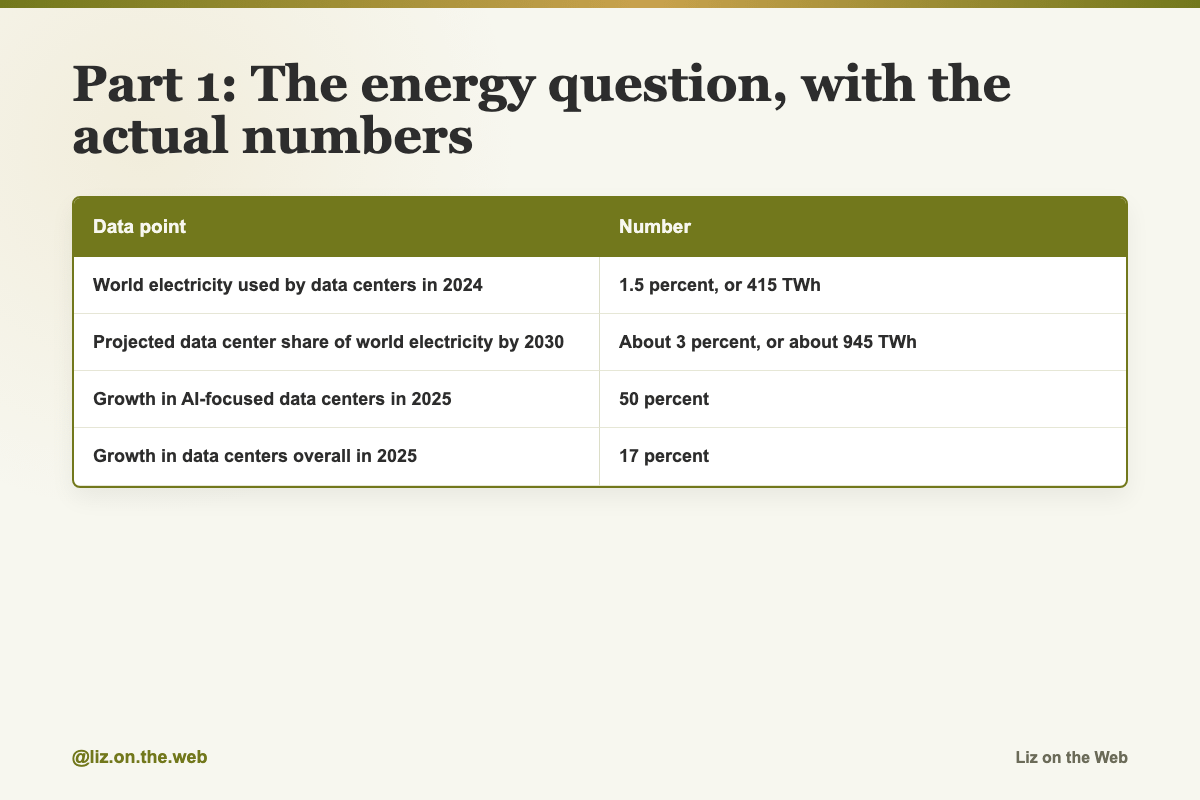
Data point / Number
World electricity used by data centers in 2024: 1.5 percent, or 415 TWh
Projected data center share of world electricity by 2030: About 3 percent, or about 945 TWh
Growth in AI-focused data centers in 2025: 50 percent
Growth in data centers overall in 2025: 17 percent
So yes, data centers use real energy, and yes, that number is growing.
Now the other end of the scale. Epoch AI, an independent research group, found that a typical AI question uses about 0.3 watt-hours. A 1,000 watt microwave running for one second uses about 0.28 watt-hours. That is where the "one AI question is about a second of microwave" comparison comes from, and it is roughly right. Hannah Ritchie at Our World in Data helped make the comparison well known.
Here is what a heavy personal day looks like:
100 questions times 0.3 Wh is 30 Wh. An average US home draws about 1.2 kW. That works out to about 90 seconds of normal household electricity use.
Older viral graphics used 3 watt-hours per question, ten times the current credible estimate. The IEA report rejected those inflated numbers. If a chart you are shown uses 3 Wh, it is not using the current figure.
The last piece is where the growth actually comes from. The IEA points at GPU-heavy systems, called accelerated servers, which are used to train and run large models. Those account for about half of the net increase in data center energy through 2030. A company training a brand new frontier model for three months uses vastly more energy than one person asking questions over the same period.
That is the split worth keeping. Training a new model is a company-level decision about whether to build it. Asking questions of a model that already exists is a different question with a much smaller number attached. Both facts are true at once. What you do with them is yours.
Part 2: The foggy feeling has a name
Harvard Business Review published a piece by Toby E. Stuart, the Helzel Chair at UC Berkeley Haas, called The Future Is Shrouded in an AI Fog.
His point: this is reduced visibility, not darkness. You can still see. You just cannot see far. That makes long bets feel harder. A four year degree. A thirty year mortgage. One career path for decades. A clean five year plan.
The move is not to guess the future correctly. You will not know which jobs change first, which tools win, or what five years from now looks like. The move is to build more options, so more doors are open whichever way it goes.
Five things that hold their value no matter which way it breaks:
Put your context in one place. Set up one Project for the thing you do most. Add your context, your voice, and your reference files once. Then stop retyping your setup into every chat.
Build trust. A small group of people who trust you is a strong asset. Show up often, talk like a person, help before you ask for anything, be clear and honest. Trust is slow, and it is hard for AI to replace. Two hundred people who open your emails beat two hundred thousand who scroll past.
Learn on purpose. The real flexibility is how fast you can learn a new area when your old one changes. Pick one new thing, learn a little each week, use it in public, and teach it back in plain words. Teaching is what makes it stick.
Make one public thing. Something small with a real address on the internet. A page, a tool, a guide. Being the person who makes real things holds up regardless of which tool wins.
Start one small income stream that uses AI. A weekend product, a freelance service, a small digital product. The money is not the point at first. Having a second bet running changes how the first one feels.
Pick one. Not five. Small work done often beats a big plan you never start.
Part 3: Where your attention actually goes
There is real data here, and it is more interesting than the usual screen-time lecture.
An analysis by GWI, covering more than 250,000 adults across over 50 countries, was shared by John Burn-Murdoch of the Financial Times. It found social media use peaked in 2022 and has fallen every year since. In developed markets, average daily social time is down almost 10 percent, the first steady drop in ten years.
Around the same period, Appfigures reported that ChatGPT became the most-downloaded app in the world, beating Instagram and TikTok for the first time. Reported user numbers went from about 100 million monthly users in early 2023 to around 900 million weekly users by early 2026.
The strategist Matt Paige put an explanation on top of that data. He argues people used social media for five jobs, and AI now does four of them better. Treat the data as data and his explanation as an argument, because a decline in one thing does not prove another thing caused it.
The five jobs, and where they now go:
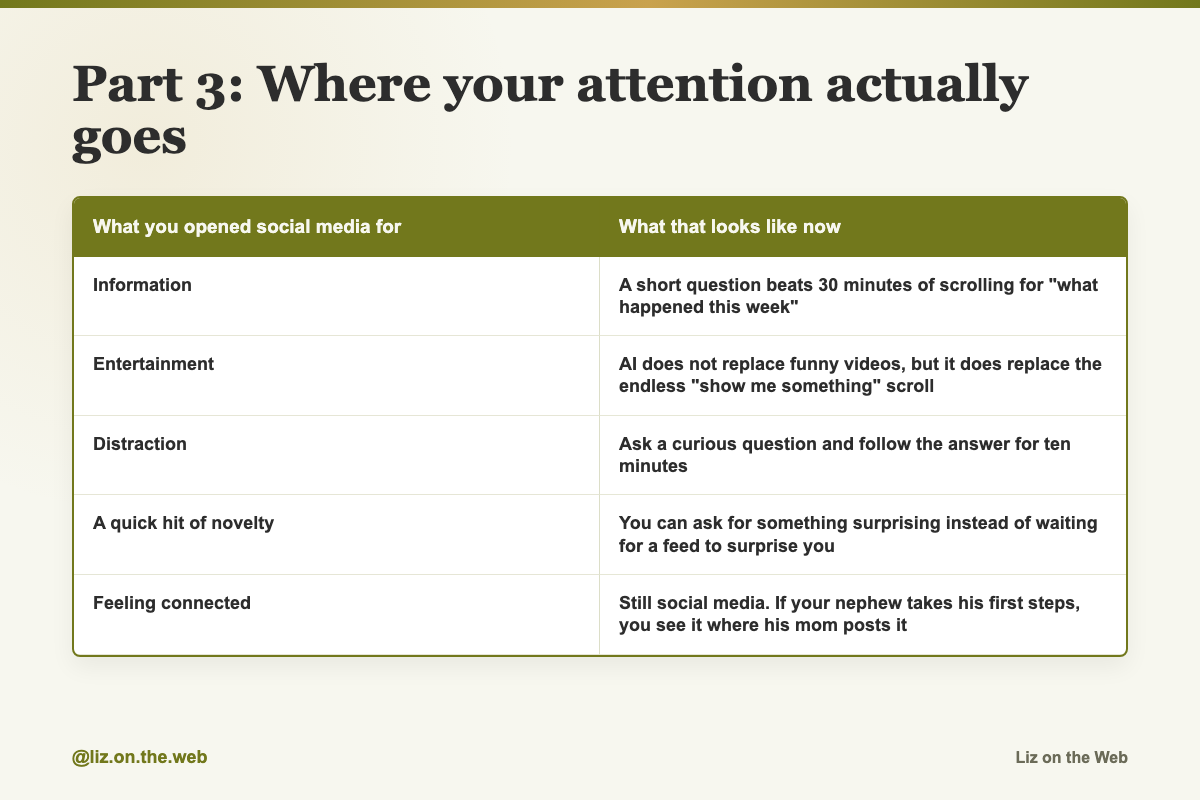
What you opened social media for / What that looks like now
Information: A short question beats 30 minutes of scrolling for "what happened this week"
Entertainment: AI does not replace funny videos, but it does replace the endless "show me something" scroll
Distraction: Ask a curious question and follow the answer for ten minutes
A quick hit of novelty: You can ask for something surprising instead of waiting for a feed to surprise you
Feeling connected: Still social media. If your nephew takes his first steps, you see it where his mom posts it
Try this yourself. Notice which of the five you are reaching for next time you open an app out of habit. Four of them have a swap. One of them does not, and that one is worth protecting.
If you want to put the reclaimed time somewhere, these are the ideas people build first, with rough build times attached:
A personal newsstand that pulls from sources you choose and writes one weekly digest. About 2 hours.
A habit tracker that nudges you and writes a weekly review. About 3 hours.
An inbox triage setup that finds the five emails that matter and drafts replies. About 1 hour.
An idea validator that researches a market and competitors before you commit. About 2 hours.
A weekly planner that reads your calendar and your last seven days and tells you what to focus on. About 2 hours.
Those are ideas, not instructions. The build steps come later in this course.
Part 4: The predictions, marked as predictions
Everything in this part is a forecast. None of it has happened.
The 2028 forecast. Jack Clark, an Anthropic co-founder and head of Policy at the company that makes Claude, wrote in his Import AI newsletter, issue 455, that he puts a 60 percent or higher chance on AI doing AI research and development with no human involved by the end of 2028. He gives a similar 60 percent chance to recursive self-improvement by the same date, which in plain words means AI helping build its own successor.
What that number rests on is worth knowing. Researchers track how long an AI agent can work on its own before something breaks, which they call time-horizon length. An independent evaluation lab, METR, has measured this over time and found it roughly doubling every four months. If that doubling slows, the date moves further out. If it speeds up, it moves closer. So the forecast is a bet on a trend line continuing, not a schedule.
His suggested response is steady, not dramatic: learn to build one small agent, learn to judge AI output rather than just produce it, learn one set of connected tools deeply, ship one small thing other people can click, and understand the rules side, including model evaluations and laws like the EU AI Act.
Three softer predictions. These circulate widely and have no data behind them at all. Hold them loosely.
Talking will take over from typing, and dictating will become the normal way people work with AI.
More than half of professionals will have at least one agent working for them daily.
Companies past about 20 people will hire someone whose job is running their AI systems.
One more, from the hardware side. Jensen Huang, CEO of NVIDIA, gave a Stanford lecture called The Compute Behind Intelligence. He said computing got about a million times faster over the last decade, which is part of why AI felt like it arrived everywhere at once. He also said the energy computing will need is far beyond today's supply, on the order of a thousand times more. Both figures come from the head of a company that sells AI chips, so weigh them accordingly.
Part 5: A filter for scary claims
Huang pushed back on AI doom claims in that lecture, saying some of them "are all being made up." His filter is a useful one, and it cuts in every direction, including at him.
Ask whether the claim could be proven wrong. If no evidence could ever prove it false, it is a fear story, not a checked fact. That test applies just as much to a chip executive saying the risks are invented as it does to a headline saying everything is about to end.
Then do the thing that actually resolves it. You learn more from using the tool on one real task than from reading one more panic post, and more from checking one real number than from arguing about a screenshot.
Copy and paste
The energy math
Keep this so you can check any energy claim you get sent.
100 questions x 0.3 Wh = 30 Wh total
Average US home draw: about 1.2 kW
30 Wh / 1.2 kW = about 90 seconds of normal household use
The fear filter
Run any alarming AI headline through these four questions before it changes what you do.
Can this claim be checked?
What evidence would prove it wrong?
Is this a fact, or is it a fear story?
What is one small task I can try with AI today?
The direction questions
Ask these when you are trying to decide what to learn next.
Where is this field clearly heading?
What skill will people need in two years?
What tool will everyone wish they understood later?
What problem is still small now but growing fast?
The control questions
Ask these when a headline leaves you feeling stuck.
What can I control here?
What can I make clearer?
What skill can I build?
What proof can I create?
What would make me hard to ignore?
Watch out
Comparing your questions to the cost of training a model
These are two different numbers and they get mixed together constantly. Training a new frontier model is a company decision measured in months of heavy compute. Your questions are measured in fractions of a watt-hour.
Passing on a graphic without checking the figure
Old charts using 3 watt-hours per question are still circulating. The current credible estimate is about 0.3. Check which number a chart is built on before you share it.
Treating a correlation as a cause
Social media time is falling, and AI use is rising. That is two facts. The explanation that one caused the other is an argument someone made, and it may be right, but the data does not prove it.
Repeating a prediction as if it happened
The 2028 forecast is a probability someone assigned to a trend continuing. The three softer predictions have no data behind them at all. Say "he predicts" out loud when you repeat them.
Taking a number from someone who sells the thing
Chip company figures on how fast computing got and how much energy it will need are real numbers with a commercial interest attached. So is a model company's forecast about models. Note the interest, keep the number, and go find a second source.
Trying to predict your way out of the fog
You will not guess which jobs change first. Building options works whether or not you guessed right. Predicting only works if you guessed right.
Building five things at once because five sounded doable
Every list in this lesson has five items. Pick one from one list. Small work done often is what actually moves.
Swapping the one job AI does not do
Four of the five reasons people open social media have a decent AI swap. Feeling connected to actual people is not one of them. Keep that one where it lives.
Check yourself
[ ] I can say what share of world electricity data centers used in 2024, and the 2030 projection.
[ ] I know roughly what one AI question costs in watt-hours, and what it compares to.
[ ] I can explain the difference between training a model and using one.
[ ] I can name which of the five social media jobs AI does not replace.
[ ] I can state the 2028 forecast, who made it, and what trend it rests on.
[ ] I marked the three softer predictions as unsourced guesses in my own head.
[ ] I picked one of the five career options to build, and only one.
[ ] I ran one claim through the fear filter.
Do this now
Write down the one AI claim that has been sitting in the back of your head, the one that makes you hesitate. Run it through the four fear filter questions and see whether any evidence could prove it wrong.
Keep going
Next in AI for Entrepreneurs:
Part 6: Models explained, and why one favorite is a trap
Part 7: The four Claudes, and which one you actually want
Part 8: Fast or deep: picking a model per task
Every part of this course sits in reading order in the free AI for Entrepreneurs course outline.
This part is free, start to finish. Subscribing keeps the rest of the course coming and opens the paid parts.
Tell me in the comments which AI headline made you nervous this month, and I will point you at the right next part.